Call: +44 (0)7963394449

Hello, I'm Philip, and I work as a freelancer in the exciting fields of data analysis, modelling, automation, and process improvement. I hold a first-class degree in Maths and Physics, and a PhD in mathematical modelling and numerical analysis from Oxford University. I have spent nearly three decades conducting research in both the steel, aluminium and aerospace industries, and I am a recognised expert in aluminium rolling. This experience has also enabled me to develop transferable skills such as software development (C++, C#, Fortran, .NET, Full Stack Web Development, APIs), modelling (stress/strain, thermal, fluids, solidification, discrete event), data analysis (statistics, data mining/analytics, databases), and intelligent control systems (Level 2/3 systems).
This highly interactive website was developed by Metec, leveraging a suite of technologies including ASP.NET, APIs, C++, C#, APIs, Tailwind CSS, HTML, CSS, Hangfire, and Remote Services. It features a variety of mathematical and numerical models designed for client use, offering extensive functionality and advanced computational capabilities. Available models, such as the Physics of Rolling, heat transfer, numerical analysis, and Discrete Event Simulation (DES), provide robust tools for tackling complex analytical tasks. Registration is required to access the applications. For those who are not existing clients, a simplified version is available to explore the features.
Recent clients have hired Metec to analyse their direct chill casting facility with the goal of increasing capacity through major capital investment. Major investments will influence future growth in the months and years to come. However, it can be very difficult to predict the real return on investment projects. Metec uses simulation to visualise the future impact of investments in machinery, personnel, or technology in seconds, not years. This approach provides quantitative information that may be missed by other methods. Simulation also helps to mitigate potential issues before implementation.
Another client has hired Metec to develop a bespoke vision system using high-speed industrial cameras, specialised lights, and software systems. This application utilises advanced image recognition techniques and data analytics to provide reliable feedback and improve product quality from a multi-million pound investment.
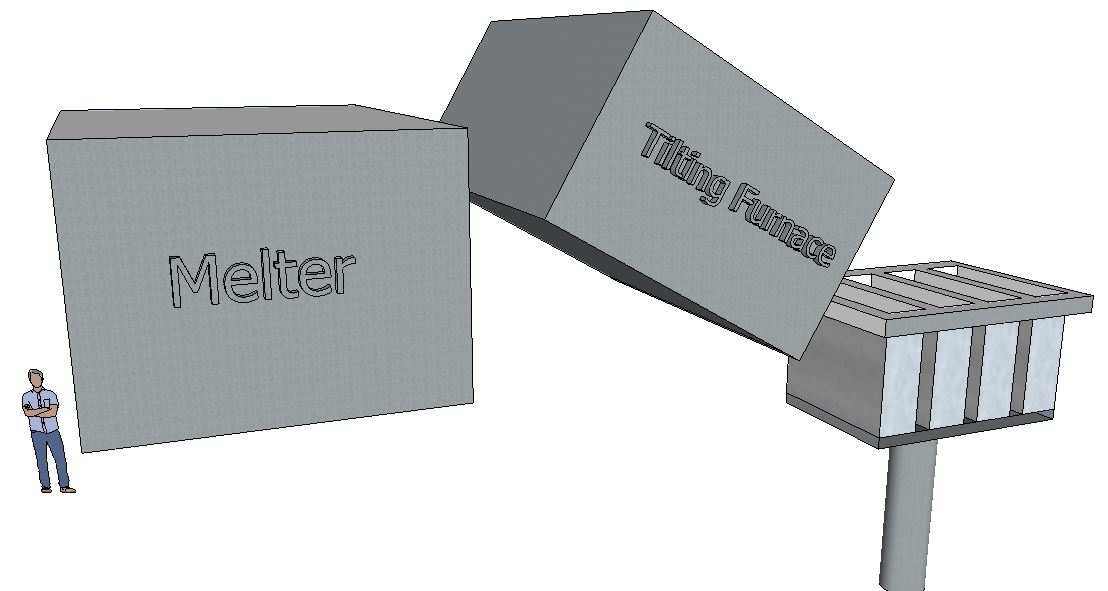
An online simulation model of the DC casting process is available (utilising DES), which is particularly useful for understanding the complex queuing systems that develop between the melter, holder, and casting pit over time. This simulation provides answers to typical questions such as whether a production facility or its modifications can meet increased production demands, and how changes to operational procedures might affect the overall delivery performance of the plant.
Simulations of this type are often aimed to:
- Investigate the feasibility and potential effects of introducing a new casting line or modifying an existing one, providing hard quantitative data instead of relying on anecdotal evidence.
- Explore alternative equipment, plant layouts, and resourcing strategies, using experimentation to identify and implement the most effective scenarios.
- Gain insights into the day-to-day operations of the production line, or to investigate specific parts of the line to identify possible improvements.
- Establish key variables that affect the performance of a casting line and understand their interactions.
- Identify and eliminate potential bottlenecks in metal flow, slab/scrap handling, and their interactions.
- Investigate the effects of extreme operating conditions, such as breakdowns, outages, and other disruptions.
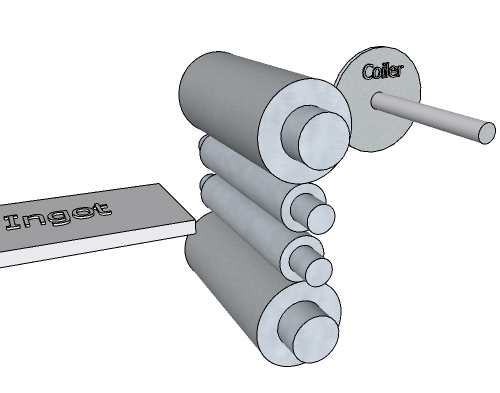
The link provides access to a comprehensive mathematical model for the aluminium hot rolling process. Hot rolling involves reducing a slab of approximately 600mm thickness down to plate material with thicknesses ranging from 6-300mm, and further down to as low as 2mm into coil for further processing on a cold rolling mill. Fast and accurate calculations of the roll separating forces are available, along with roll torque, motor power, slab temperatures, and many other parameters.
Consider the following as some uses for the model:
- Online systems for pass schedule generation and automatic set-up.
- Minimise costly mill trials for product and process development. Simulate the potential impact of trials.
- Evaluate the impact of different hot mill configurations on the process and workpiece.
- Aid with hot mill design or modifications, and evaluation of throughput.
- Understanding and training of the hot mill process.
- Perform sensitivity studies to determine which variables should be measured and controlled to achieve the desired quality or final properties.
- Predict variables that cannot be easily measured, e.g., bulk slab temperatures, roll temperatures.
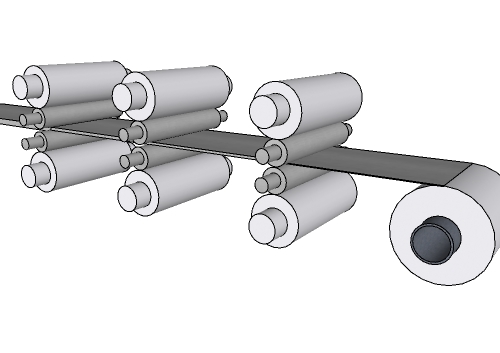
An online hot tandem mill model will soon be available, which will enable fast and accurate calculations of roll seperating forces, motor powers and torques and strip & coil temperatures for each rolling stand. It is a natural extension of the hot mill model enabling the user to investigate the entire process line from slab to coil. As with the hot mill model, the tandem mill model will enable the user to consider the following:
- Analyse the affect that different mill configurations have on product and process perfromance from single stand hot reversing with twin-coilers to hot reversing mills with an inline 2-5 stand hot tandem mill
- Design new mills or evaluate existing mill designs in terms of throughput, mill motor size, maximum seperating forces, motor speeds, etc.
- Evaluate new products using simulation prior to costly mill trials
- Identify key parameters that affect the performance of the production line
- Monitoring the improvements to ensure success. Reusable simulations encourgae continuous improvement
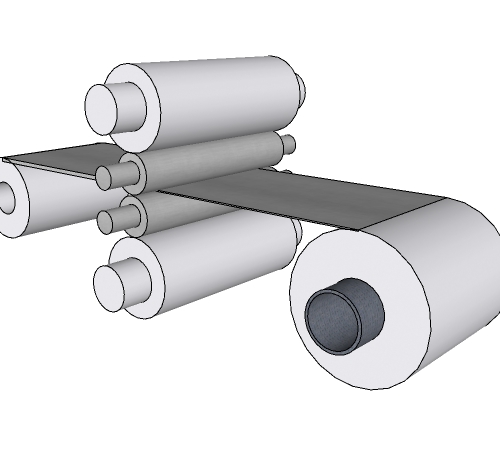
I have been dealing with problems in the flat rolling process for over 30 years. This included mathematical modelling, experimentation and consulting. Nearly all work proceeded with mathematical modelling of the process to establish the boundaries and sensivitiy of the equipment. During my carreer modellling has been used extensively in the follwoing areas:
- Minimise mill trials for product and process development
- Evaluate the impact of different mill configurations on the process and work piece
- Aid with hardware design or modifications, and evaluation of throughtput
- Understanding and training of the phyical process
- Perform sensitivity studies to determine which variables should be measured and controlled to achieve the desired quality or final properties
- Predict variables which cannot be easily measured (e.g. bulk temperatures, metallurigical attributes)
- Mill set-up and control through use of on-line systems